


Learn more
From Product Concept to Production Line
Automation doesn't start in production, it starts with the product.
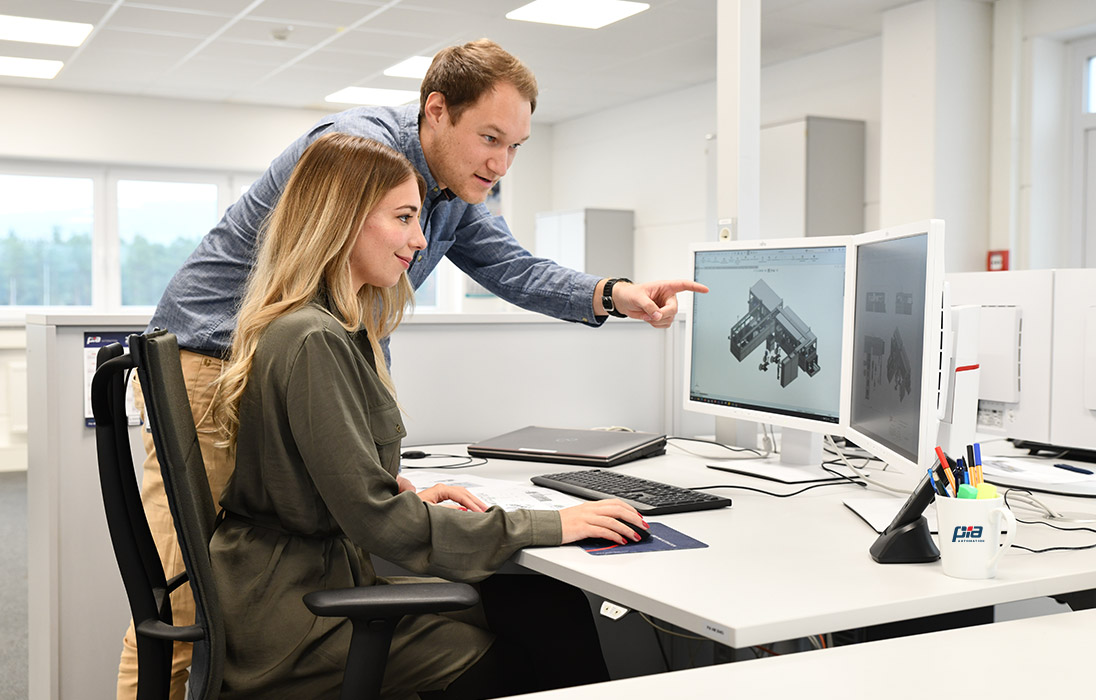
Ensuring automation readiness right from the product design stage
A global leader offering everything under one roof
PIA supports companies from the very beginning: from the development of automation-ready products to stable mass production, including humanoid robots.
Why a holistic approach is crucial
Benefits
Many automation projects reach their limits not because of the technology, but because of decisions made much earlier. Products are often developed without considering subsequent assembly, testing, or handling processes.
The result: high adaptation costs, unnecessary complexity, and limited scalability.
This is exactly where PIA comes in! Because successful automation begins long before the first system is built.

We don't view automation as a single machine, but rather as an integrated system that spans everything from product design to ongoing operations. Our goal is to design products and production processes so that they can be automated efficiently, reliably, and with future-proof capabilities right from the start. This reduces risks, accelerates ramp-up, and creates long-term competitive advantages.
- Phase 1: Product Development with a Focus on Automation
- Phase 2: Process and System Concept
- Phase 3: Construction of the Production Line
- Phase 4: Ramp-up, Scaling, and Global Rollout
- Phase 5: Service, Lifecycle, and Further Development
Phase 1: Product Development with a Focus on Automation
Phase 1: Product Development with a Focus on Automation
Automation-Ready Product Design (DFA)
We bring our experience in assembly, testing, and mass production to bear as early as the product development phase. Together with the development teams, we analyze how product designs can be optimized for automation.
In doing so, we consider, among other things:
- Handling of components
- Tolerances and joining strategies
- Testing and quality requirements
- Variant diversity and future scalability
This results in products that are not only technically impressive but can also be produced economically and reliably.
Phase 2: Process and System Concept
Phase 2: Process and System Concept
The right level of automation at the right time
Based on the product design, we develop robust process and equipment concepts. We think in terms of modules and platforms rather than individual solutions. A particular focus is on developing and validating critical manufacturing processes at an early stage. This process and procedure development is one of our core competencies, and we offer it as a standalone service in the preliminary phase.
Our focus:
- Clearly structured process flows
- Appropriate levels of automation
- Scalable plant concepts
- Validation through simulation and proof-of-principle tests
- Early development and validation of critical manufacturing processes
The result is solutions that adapt flexibly to your needs and grow with you, from the initial pilot project through to mass production.
Phase 3: Construction of the Production Line
Phase 3: Construction of the Production Line
Precision, Quality, and Efficiency in Series Production
PIA designs and builds high-precision production lines for sophisticated products. Our systems integrate assembly, inspection, marking, and packaging into seamless, stable processes.
Depending on the application, we integrate:
- Robotics and handling systems
- Image processing and inline inspection technology
- Laser and marking systems
- Digital and AI-supported functions
- …and more
All with a clear goal: maximum process reliability, high OEE, and consistent product quality.
Phase 4: Ramp-up, Scaling, and Global Rollout
Phase 4: Ramp-up, Scaling, and Global Rollout
From the first production part to international manufacturing
PIA provides close, structured support throughout the production ramp-up. Together, we ensure that systems operate stably and quickly and can be reliably replicated at additional sites.
Through standardized platforms and clear concepts, we enable:
- Rapid ramp-up
- Reproducible quality
- International rollouts
This creates a production landscape that works today and can be expanded tomorrow.
Phase 5: Service, Lifecycle, and Further Development
Phase 5: Service, Lifecycle, and Further Development
Long-term partnership throughout the entire lifecycle
We remain by your side even after commissioning. With services, upgrades, and retrofit solutions, we ensure that your systems remain efficient over the long term.
Our lifecycle approach includes:
- Maintenance and technical support
- Adaptations for new product generations
- Optimization of existing systems
- Integration of new technologies
- Monitoring and analysis with our PIAApps
So that your production doesn’t come to a standstill, but continues to evolve.


Questions?
Get in touch
Let’s talk about your product and your production. Whether you’re developing a new product, scaling up, or modernizing existing equipment—we’ll help you make your products automatable and your production future-proof.

Questions? We have the answers.
Here you'll find answers to the most important questions about automation.
Design for Automation means designing products during the development phase so that they can be manufactured efficiently, reliably, and cost-effectively using automated processes. Requirements related to assembly, testing, and production processes are taken into account as early as the design phase to reduce technical risks, minimize the need for later adjustments, and enable rapid industrialization.
Many challenges in production arise from decisions made during development. If automation is considered early on, processes can be implemented, stabilized, and scaled more easily. This reduces effort, shortens ramp-up time, and improves overall quality.
An automation-ready product is characterized by clear structures, easy-to-handle components, and coordinated tolerances. Joining strategies, testing concepts, and product variants are also defined in such a way that they can be implemented safely and efficiently in automated processes.
Ideally, as early as possible. Important decisions can already be made during product development. The earlier automation expertise is incorporated, the fewer adjustments will be needed later and the faster the transition to series production will be.
The optimal level of automation depends on the product, production volume, and business objectives. The key is a balanced approach that takes efficiency, flexibility, and investment costs into account and can be scaled as needed.
A proof-of-principle test verifies at an early stage whether a manufacturing process works technically and can be implemented reliably. Critical process steps are tested under realistic conditions before investing in equipment. This provides certainty and reduces risks.
A successful transition is based on clearly defined processes, coordinated plant concepts, and manufacturing steps validated at an early stage. Through structured planning, simulation, and testing, the ramp-up can be implemented quickly and reliably.
A consistent approach reduces interfaces, avoids unnecessary loops, and ensures stable processes. Companies benefit from shorter ramp-up times, higher quality, and a production system that can be flexibly scaled.