
Humanoid robots make their way onto the factory floor
Published on Nov 26, 2026
Share
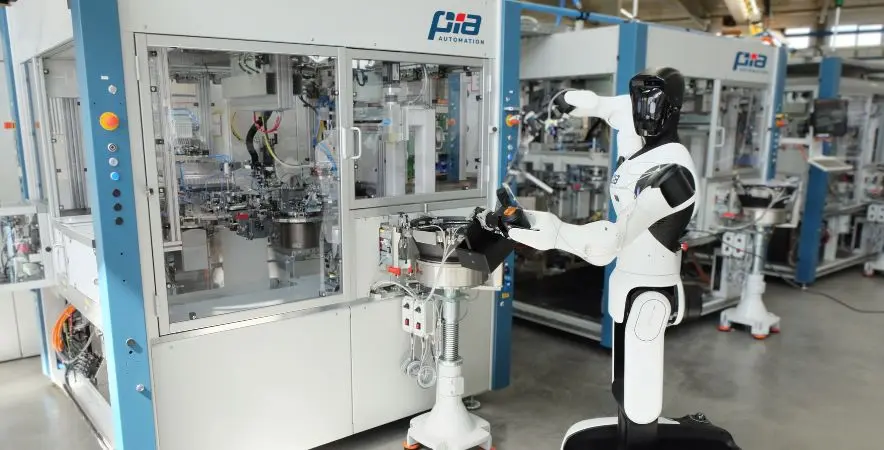
From technological promise to production reality
PIA Automation is testing AI-powered humanoid robotics in a working manufacturing environment. A joint proof of concept with Siemens in Amberg shows how the technology can be used on the factory floor and where it could play a role in the future. Amberg is a major manufacturing and development site for Siemens. Among other products, the company develops and manufactures switching, protection, and monitoring devices for industrial applications there.
The robot approaches a bin of parts, picks it up, and empties it into a feeder several meters away. It then returns the empty bin to the pickup station. For a person, this is a straightforward material handling task. For a humanoid robot, it requires precise coordination of perception, motion control, and safety functions.
PIA Automation and Siemens are using a production line at Siemens’ Amberg plant to investigate how to carry out tasks like this under actual production conditions. The I-Bot 2.0, a humanoid robot designed for industrial applications, supplies the line with connector contacts and plastic housings for relay production. Until now, operators have supplied these parts by hand.
Process stability takes priority
As the system integrator for the pilot project, PIA Automation is incorporating the I-Bot 2.0 into selected stages of the existing manufacturing process. AGIBOT, PIA’s robotics supplier and joint venture partner, provides the hardware. The first objective is to establish whether the system can perform its material handling tasks accurately and reliably over time. Process stability and equipment availability take precedence over high throughput. The partners currently allow six minutes for a full cycle, from approaching the bin to returning it empty.
“Material feeding tasks already show how well humanoid robots can complement conventional industrial robots,” says Stefan Schneeberger, a software engineer at PIA Automation who shares responsibility for the proof of concept. “Conventional automation systems, such as six-axis robots, can often handle heavier payloads and achieve shorter cycle times. Humanoid robots like the I-Bot 2.0 offer greater flexibility. They can move between work areas as needed and take on different tasks at each one.”
A broader role for humanoid robotics in automation
PIA has been developing humanoid robotics since 2024. In early 2026, the company consolidated these efforts in a dedicated business segment. The focus is on applications that are difficult to automate with stationary equipment. These include routine tasks still performed by hand and operations where material flows change.
Dr. Quanji Cai, Head of Physical AI & Humanoid Robotics Europe at PIA Automation, explains the development goals. “With this technology, we want to significantly expand what conventional automation can do without replacing it. What matters is putting the flexibility of humanoid robots to work where it adds value in manufacturing and where other solutions have so far run up against their limits.”
PIA is also exploring potential uses in manufacturing environments with special requirements. One example is medical device manufacturing, where production often has to meet stringent cleanroom requirements.
Reliable perception for safe operation
In any industrial application, a humanoid robot needs an accurate picture of its surroundings to interact safely with people and objects. The I-Bot combines data from 3D cameras and LiDAR for spatial perception. Additional sensors measure distance, force, and pressure to support tasks such as gripping parts securely.
Combining several sensing methods helps compensate for the limitations of each one. Transparent or highly reflective surfaces, as well as obstructions that block the sensor’s line of sight, can affect LiDAR measurements. Cameras, in turn, can produce unreliable data when lighting changes or when shadows or reflections are present. Using both data sources can reduce the impact of these errors and improve the robot’s overall perception.
“For the proof of concept, we currently program each I-Bot individually, just as we would a conventional industrial robot. For object recognition, though, we use artificial intelligence. We generated a large dataset and used it to train our own vision system, which we can transfer to other I-Bots with only minor adjustments,” says Schneeberger.
Feedback from the plant and next steps
The project partners are working to reduce potential sources of error in the workflow and further improve process stability. Siemens managers and production employees have given consistently positive feedback on the progress to date under actual production conditions.
The next step is to connect the humanoid robot directly to the line’s control system. The I-Bot would then be able to start and stop its work automatically in response to signals indicating when the line needs material.
“We work closely with Siemens, and there’s a great deal of trust between us,” says Cai. “Decisions are made quickly, and direct communication between our teams in Amberg helps keep the project moving forward. Our plan is to have this industrial application fully ready for deployment in the first half of 2027.”
PIA MotionFlow Line as an industrial demonstrator
In parallel, PIA Automation is preparing its own PIA MotionFlow Line for industrial use. This fully automated production system for battery management systems uses several I-Bot 2.0 robots simultaneously. Their tasks include transporting and handling components at assembly, end-of-line, and labeling stations.
In July, PIA and AGIBOT presented the first section of the demonstration line at the 2026 World Artificial Intelligence Conference (WAIC) in Shanghai. “Our demonstration attracted a lot of attention and generated real enthusiasm. We’re very proud of that, and it encourages us to keep going with the development work,” says Cai. “Next, we’ll integrate our humanoid robots into operations in the remaining assembly cells. We’re aiming to have a market-ready version of the entire line in the first half of 2027.”
