
Large-scale assembly system for e-drive systems
PIA Fact Check
- Cycle time of 49 seconds
- 78 assembly stations and 27 robotic cells integrated into the production layout
- Technical availability of 99% during production operation
- Batch size one manufacturing across three product variants


One of the largest projects in PIA Automation’s history delivered on schedule
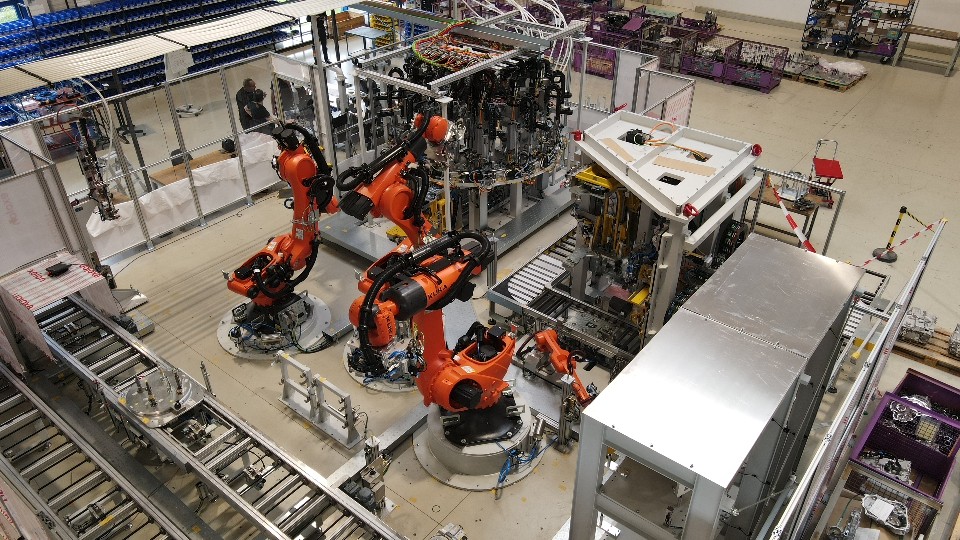
With 78 assembly stations and 27 robotic cells spread across more than 5,600 square meters, the assembly system currently being installed by PIA Automation for the BMW Group at its Steyr plant in Austria is a project of exceptional scale. Across two vertically arranged production levels, the highly automated system first assembles transmissions for electric vehicles before combining them with electric motors to create complete e-drive systems. Commissioning and final acceptance of the remaining system sections are scheduled through 2027.
The customer’s requirements included a high degree of automation, maximum system availability, and integration into a BMW-specific software environment. “This required an intensive training phase on our side to ensure seamless integration of our solutions into the customer’s software architecture,” explains Markus Harlander, Project Manager at PIA Automation.
Fully automated gear meshing in transmission assembly
One of the key automation challenges within the transmission assembly process is the precise alignment and interlocking of gears. In this operation, three gears are automatically aligned, meshed with one another, and inserted into the transmission housing with high precision. The system is capable of processing different transmission variants in batch-size-one production without requiring any changeover time. Automatic gripper-changing systems within the assembly cell adjust independently to the respective product variant, ensuring maximum flexibility and uninterrupted production flow.
Twelve synchronously controlled fastening spindles for e-drive assembly
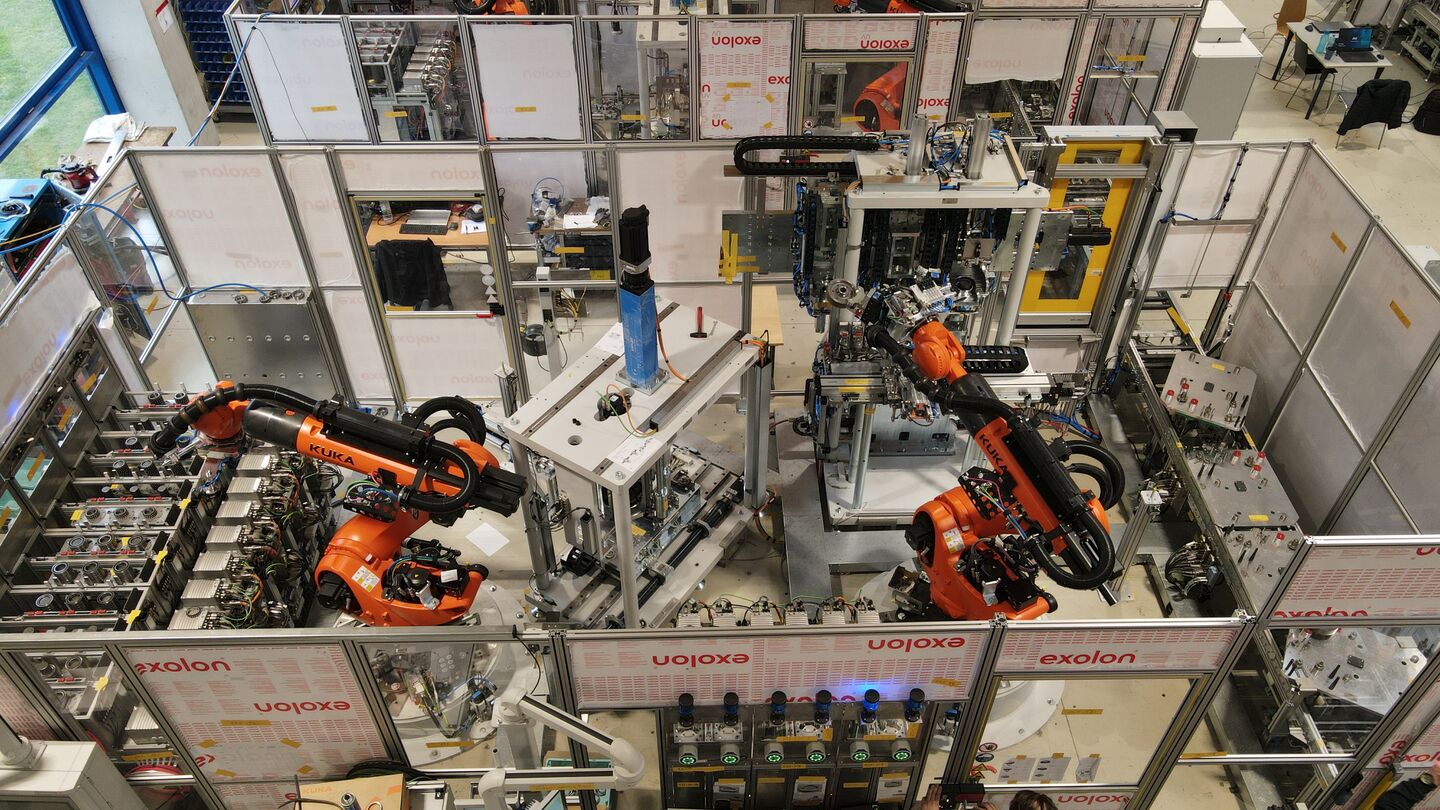
Maximum precision is also required during the “marriage” process, where the pre-assembled transmission is joined with the electric motor. Within a robotic cell, electric motors are conveyed into the station on highly precise assembly fixtures, where they are combined with the transmissions and secured using twelve synchronously controlled fastening spindles operating simultaneously.
Like this station, the majority of the assembly cells are designed as fully automated systems. To ensure continuous quality assurance, all fastening and joining processes are monitored and documented based on force-displacement curves, torque values, and angular measurements.
Virtual commissioning accelerates development processes
The high level of automation, supported by a total of 46 robots, enables a cycle time of just 49 seconds. In addition, the system is designed to achieve technical availability of up to 99%. To manage the complexity of the project, PIA Automation has relied on Virtual Commissioning methods from the very beginning. Using digital simulations, programming sequences and station processes can be tested and validated before physical commissioning takes place. The resulting insights are then incorporated directly into the ongoing work of the 20-member engineering team.
“The scale of this project and its technical complexity are unprecedented for PIA Austria,” says Harlander. “Virtual Commissioning helps us significantly reduce the number of review loops and streamline development processes. The project is being implemented both at PIA Austria, which serves as the competence center for powertrain applications within the PIA Group, and in close cooperation with PIA Croatia, where complete robotic cells are assembled and subjected to Factory Acceptance Testing (FAT) prior to delivery.
Decades of automation expertise
PIA Automation has been developing and delivering systems for the fully automated assembly and quality inspection of e-mobility components for around 20 years. The transmission assembly system marks the first joint project between PIA Austria and the BMW Group’s Steyr plant. However, PIA Automation and the BMW Group have already successfully collaborated on numerous projects at other production sites.
“We are particularly pleased that our long-standing expertise in highly efficient automation technology, our extensive know-how in e-mobility applications, and the positive experience gained from previous joint projects were decisive factors in the BMW Group choosing PIA Automation to realize this exceptional system,” says Franz Reiter, Business Segment Manager e-Drive & Powertrain at PIA Automation. “The project remains fully on schedule, and we look forward to seeing the system enter regular production operation for the first time.”

Questions?
Get in touch with us
This is the quickest way to reach your contact for the automated production of E-Drive products:
